

Imagine standing on the deck of the Titanic as the ship begins to sink.
The alarms are sounding. People are panicking. Water is rising. The obvious response is rescue. Find the lifeboats. Get people off the ship. Save as many as possible before it is too late.
That picture has shaped much of the way Christians have understood the world—and, consequently, the way we have understood work.
The world is sinking. Sin has corrupted everything. Jesus is coming to rescue people. So our primary task becomes getting people into the lifeboat.
There is truth in that picture. People do need to be rescued. Sin is real. Redemption is essential.
But what happens when the lifeboat becomes our entire theology of mission?
What happens to the world God created? What happens to work? What happens to culture, business, government, education, science, agriculture, technology, art, and community? What happens to the millions of Christians who spend most of their waking hours working in those places?
J. Darrell Charles, in Our Secular Vocation, offers a provocative alternative: perhaps we need to move from a lifeboat theology to an ark theology.
A lifeboat assumes that the ship is doomed. Its purpose is rescue. Get people out. Leave the sinking vessel behind. In a lifeboat theology, the world can easily become something Christians are trying to escape rather than something in which they are called to faithfully serve God. The church becomes primarily concerned with getting people ready for heaven. Work becomes something we endure until we can do something more spiritual. The marketplace becomes a place where Christians happen to spend their weekdays—a place where we might witness to our colleagues, pray for our clients, and hopefully survive until Sunday.
Charles identifies several ways this distorted understanding appears in the church: the marketplace is sometimes treated as a place merely to evangelize, an obstacle to “real ministry,” a necessary evil endured for a paycheck, or something Christians would gladly leave if they could enter professional ministry.
The problem is not that evangelism is wrong. The problem is that we have reduced the purpose of Christian presence in the workplace to evangelism. We have made the workplace the mission field but failed to see the worker as a missionary. And we have sometimes failed to see the work itself as part of God’s good purposes.
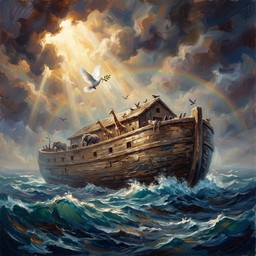
Charles draws attention to another biblical image: the ark.
The ark was not a lifeboat. Noah did not simply abandon creation. God preserved people, animals, and creation through judgment. And after the flood, God established a covenant—not merely with Noah, but with creation itself. The story did not end with escape. It continued with renewal, stewardship, and God’s ongoing purposes in the world. That distinction matters enormously for a theology of work.
Charles describes “lifeboat theology” as a framework that assumes that because of sin, the goodness of creation and God’s original purposes for humanity have essentially been eliminated. In contrast, “ark theology” recognizes that God’s creational purposes continue and that sin, while profoundly real, does not become the whole story.
Charles describes work as participation or cooperation in God’s purposes and activity within the created order. That is a very different and significant starting point.
There is another important difference between an ark and a lifeboat. An ark has a purpose beyond escape. It carries life through judgment toward a future. It preserves what God intends to continue. And that gives us a different understanding of Christian presence in the world. Jesus prayed, “I have sent them into the world.” He did not pray that his followers would be removed from the world. Charles points to John 17 as evidence that Christian mission is fundamentally about being in the world rather than withdrawing from it. The church is not an escape hatch from creation. The church is a people sent into creation.
If we have a lifeboat theology, we will ask: How do I get people out? If we have an ark theology, we begin asking: How do I help people faithfully steward what God has entrusted to us?
That changes the questions we ask about business.
- Not simply: “Is this business Christian?” But: “Does this business serve human flourishing?”
- Not simply: “Can I evangelize my employees?” But: “How am I developing the people God has entrusted to me?”
- Not simply: “How can I make money?” But: “What is wealth for?”
- Not simply: “How do I protect my company?” But: “How can this company contribute to the flourishing of our community?”
- Not simply: “How do I survive in a corrupt system?” But: “What would faithful stewardship look like here?”
These are not merely business questions. They are discipleship questions.
If the church embraces only a lifeboat mentality, it may produce Christians who are very good at escaping the world but poorly equipped to serve it. But if the church embraces an ark-shaped understanding of vocation, discipleship expands. At DML, we work with churches to teach Christians how to pray about their businesses, how to lead, how to hire, how to fire, how to handle money, how to make ethical decisions, how to navigate power, how to create jobs, how to resolve conflict, how to care for creation, how to serve customers, how to pursue excellence, how to respond to injustice, how to steward profit, how to develop people, how to recognize God’s activity in ordinary work. The goal is not to make everyone a pastor. The goal is to help every believer understand that wherever God has placed them, they are participating in His world and are responsible for how they steward that place.
The question is not whether we need lifeboats. We do. People need rescue. People need salvation. People need Christ. But rescue cannot be the whole picture. The biblical story begins with creation, moves through the Fall, reaches its center in redemption and moves toward restoration. The destination is not simply souls escaping earth. Scripture points toward a renewed creation—a new heaven and a new earth. That means our theology of work should not begin with the assumption that the world is disposable. It should begin with the conviction that God cares about what He has made. And if God cares about His creation, then we should care about it too. If God cares about work, we should care about work.
The question facing the church is not simply: “How many people can we get into the lifeboat?” The question we need to ask is: “What kind of people are we sending into the world?”
The mission of God is not only about rescuing people from the world. It is also about forming people who can faithfully live within God’s world because the God who created the world has not abandoned it—and neither should His people.
To see how this is happening with the Council of Protestant Churches in Cameroon, watch this video: